You can't just take the course. What Florida requires.

Here is the sentence that catches people.
Section 1007.25 of the Florida Statutes says a student must demonstrate competency in civic literacy "by achieving a passing score on an assessment and by successfully completing a civic literacy course."
And, not or.
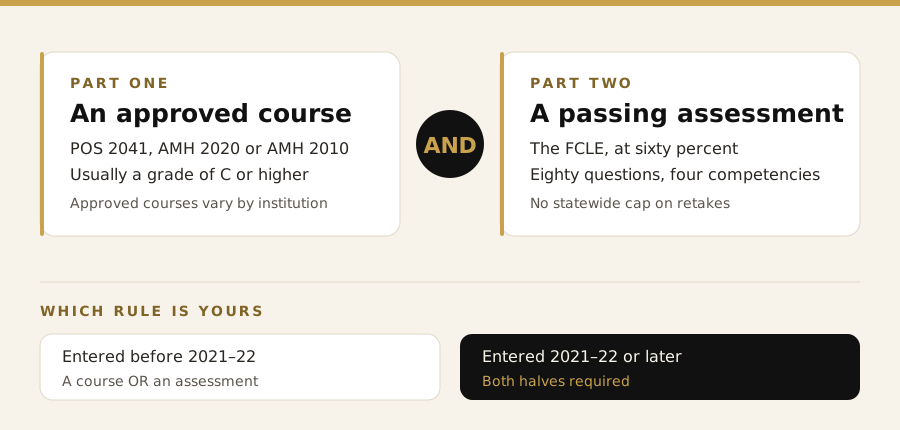
I bring it up because I have watched students plan around the wrong version of this. They take POS 2041, they do well, they assume they are finished, and then a degree audit tells them otherwise in their last term. That is a rough week, and it is avoidable.
Which rule is yours depends on your catalog year
This is the part that makes the requirement confusing, because two different rules are both true, just for different people.
- If you first enrolled before the 2021-22 catalog year, you generally satisfied the requirement with a course or an assessment. One or the other.
- If you first enrolled in 2021-22 or later and you are working toward an A.A. or a bachelor's degree, you need both.
- For an A.S. or an A.A.S., the both-parts rule starts with the 2022-23 catalog year.
So when you read something online that says it is either/or, that person is probably not wrong. They are just describing a cohort that is not yours. Your catalog year decides which rule applies to you, and it is worth knowing yours precisely.
What each half actually looks like
The course half. Commonly POS 2041, AMH 2020 or AMH 2010, usually with a grade of C or higher. Approved courses vary by institution, so your advisor's list is the one that counts.
The assessment half. Usually the Florida Civic Literacy Exam. Eighty multiple-choice questions, and you need sixty percent, which is forty-eight of them. There is no statewide cap on retakes. If you want the full picture of what the exam covers, what is actually on the FCLE walks through all four competencies, and the FCLE guide covers format, timing and scoring.
Finishing one half does not finish the other. That is the whole point of this post.
Where students actually get caught
The rule itself is not complicated. The situations are. Three come up over and over.
Transfer students. Your catalog year generally tracks when you first enrolled, not when you arrived at your current school. A student who started at one Florida institution in 2020 and transferred in 2023 may be on the older rule, and a student who started in 2022 and transferred is not. Institutions can differ on how they set this, so ask which catalog year your current school has you under. It is one question and it decides everything else.
Dual enrollment. If you took an approved civics course in high school through dual enrollment, that may well satisfy the course half. It does not touch the assessment half. This is the single most common version of "I already took that class, so why is this line unsatisfied."
Students who left and came back. A break in enrollment can put you under a newer catalog year than the one you started on. If you stopped out and returned, do not assume the rule you learned at orientation is still the rule that applies to you.
The one real shortcut
There is a genuine way to satisfy both halves at once, and a lot of students already have it without realizing.
At many institutions, an AP or CLEP score covers the course and the assessment together:
- AP Government and Politics: United States, with a 3 or better
- AP United States History, with a 4 or better
- CLEP American Government, with a 50 or better
If one of those is already on your transcript, you may be done. Check before you register for anything. The full version of that check is here, including the part where a score you earned is not automatically a score your institution has on file.
What to do this week
Pull up your degree audit and find the civic literacy line. If it is unsatisfied, ask your advisor three questions: which catalog year am I under, which courses count here, and does anything already on my transcript satisfy the assessment.
Ask about both halves explicitly, every time. The failure mode is not an advisor being wrong. It is you asking "am I good on civic literacy?", them seeing the course on your transcript, and both of you walking away from a conversation that answered half the question.
Then, if you need the exam, give it a real week rather than a panicked night. The free practice test is forty questions and will tell you in about an hour which competency is costing you the most, scored by competency rather than as one number. Sixty percent sounds gentle until you are looking at a question about which branch a clause belongs to and the clock is running. If you want the number in detail, here is what passing actually takes.
A plain-English overview of the whole thing lives on our civic literacy requirement page. Requirements change, and institutions apply them differently. Confirm anything here with your academic advisor before you build a schedule around it.
Covers: American Democracy
Keep reading
Does AP Government count instead of the FCLE?
At many Florida institutions a 3 on AP Government satisfies both halves of the civic literacy requirement at once. Here is how to check if you are done.
What score do you need on the FCLE?
Sixty percent, which is forty-eight of eighty questions. Where that number comes from, and why we hold you to seventy-two.
How advisors should talk about the FCLE
Accurate, forwardable wording for the three questions advisors hear most about the civic literacy requirement, and the phrasing worth avoiding.