Does AP Government count instead of the FCLE?

Often, yes. And it is the one shortcut in this requirement that is worth checking before you do anything else.
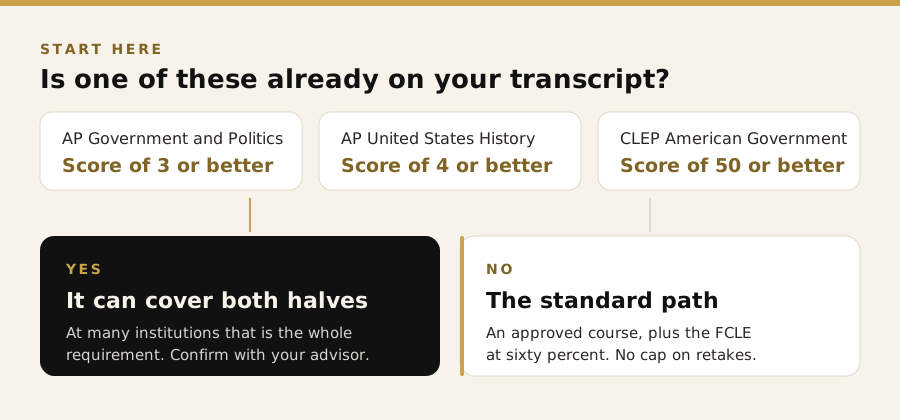
Florida's civic literacy requirement has two halves for most current students: an approved course, and a passing score on an assessment. That is section 1007.25 of the Florida Statutes talking, not a campus policy. If that is news, start here. What makes AP and CLEP unusual is that a qualifying score can satisfy both halves at once, rather than just one of them.
The scores that do it
At many institutions, these clear the whole requirement:
- AP Government and Politics: United States with a 3 or better
- AP United States History with a 4 or better
- CLEP American Government with a 50 or better
CLEP History of the United States I is also commonly accepted. History of the United States II is more often treated as covering the course half only.
Notice how ordinary those cutoffs are. A 3 on an AP exam is not a heroic score. If you took AP Government as a high school junior and have not thought about it since, it may already be sitting on your transcript doing nothing, because nobody told you it counted.
Why a single score can cover both halves
This looks like a loophole and it is not one. The logic is that a college-level civics exam, passed at a college-level score, is evidence of the same thing the requirement is trying to establish: that you studied the material and that you can demonstrate competence in it. One exam, both kinds of evidence.
That is also why the accepted list is short and specific. It is not "any AP score" or "any social studies credit." It is a named set of exams whose content lines up with the civic literacy competencies, at scores the state and your institution treat as college level.
Which means the question to ask is never "do I have AP credit?" It is "do I have one of these exams at this score, and does my institution accept it for this requirement?"
Scores you earned are not scores they have
Here is the part that catches more people than the score cutoffs do.
A score sitting in your College Board or CLEP account is doing nothing for your degree audit. It has to have been sent to your institution, received, and posted. Those are separate events, and any one of them can quietly not have happened.
This is especially common if you changed schools. A score sent to the college you attended freshman year did not follow you when you transferred. Neither did it necessarily transfer as satisfying this requirement, even if the credit itself came across.
So the check is two questions, not one: did I earn a qualifying score, and does my current institution have it on file against the civic literacy line?
How to check in about ten minutes
- Pull up your degree audit and find the civic literacy line.
- If it is unsatisfied, check whether your AP or CLEP scores were ever sent to your institution. Scores you earned are not scores they received.
- Ask your advisor directly: "Does my AP or CLEP score satisfy the civic literacy requirement here, both the course and the assessment?" Ask about both halves explicitly, because a partial answer is the thing that catches people.
Institutions apply these differently, and the list of accepted exams and scores can change. Your advisor's answer is the one that counts.
What if you never took AP?
Then AP is closed to you, because those exams are for high school students. CLEP is not.
CLEP American Government is an exam any student can register for and take, and at many Florida institutions a 50 or better satisfies this requirement the same way an AP score would. If that is a route you are considering, ask your advisor two things before you pay for anything: whether your institution accepts CLEP American Government for the civic literacy requirement specifically, and what score they require.
I will be straight with you about the trade, though. CLEP is a separate registration, a separate fee and a separate exam to prepare for. The FCLE is usually already available to you through your own institution's assessment center. For most students the FCLE is the simpler path, and CLEP is worth the detour mainly if you were going to take it for the credit anyway.
If the answer is no
Then you are on the standard path, and it is not a bad one: an approved course, plus the FCLE at sixty percent.
That is a real requirement rather than a formality, but it is finite and it is learnable. Eighty questions, four competencies at twenty-five percent each, and no statewide cap on retakes. Most students who struggle with it were not short on ability, they were short on knowing how the exam is built. What is actually on the FCLE breaks the four competencies down, the FCLE guide covers format and scoring, and the free practice test shows you where you stand today, scored by competency rather than as one number.
Nothing here is legal or academic advice. Confirm your own situation with your academic advisor before you register for anything or skip anything.
Covers: American Democracy
Keep reading
What score do you need on the FCLE?
Sixty percent, which is forty-eight of eighty questions. Where that number comes from, and why we hold you to seventy-two.
You can't just take the course. What Florida requires.
Most students think the civic literacy requirement is a choice between a course and the FCLE. For anyone who started in 2021-22 or later, it is both.
How advisors should talk about the FCLE
Accurate, forwardable wording for the three questions advisors hear most about the civic literacy requirement, and the phrasing worth avoiding.