What is actually on the FCLE?

Eighty multiple-choice questions. One hundred sixty minutes. Four choices per question, and four competencies that each carry exactly twenty-five percent of your score.
That last number is the one most students have never been told, and it changes how you should study.
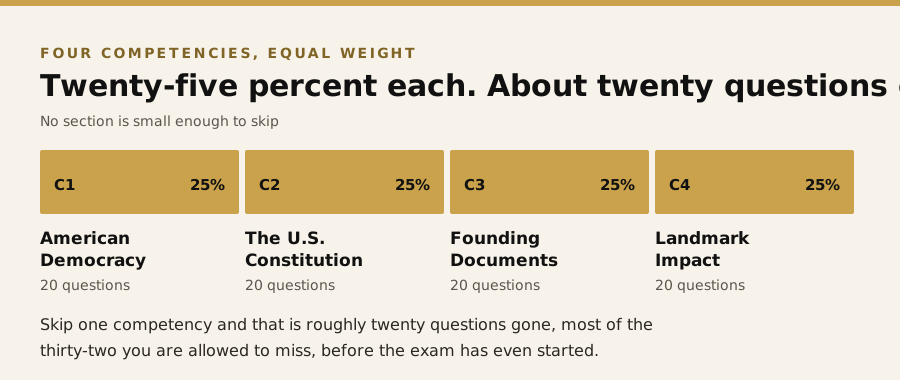
Twenty-five percent each means roughly twenty questions per competency. It also means the exam has no "small" section you can safely skip. If you decide one competency is not worth your time, you have written off about twenty questions before you sit down, and the state only lets you miss thirty-two in total.
Competency 1: American Democracy
This is the ideas competency, and it is broader than students expect. It covers the social contract, natural rights and natural law, popular sovereignty, rule of law, due process, equal protection, federalism, majority rule with minority rights, republicanism, constitutionalism, individual liberty, separation of powers with checks and balances, the Bill of Rights, and elections.
Read that list again. Those are not events or dates. They are concepts, and the exam tests whether you can recognize one when it shows up in an unfamiliar situation.
That is why memorizing definitions does not carry you here. A question will not ask "what is federalism." It will describe a dispute between a state and the federal government and ask which principle is at work. You need the idea to be portable.
Competency 2: The U.S. Constitution
This is the document itself, article by article. Article I and the legislative branch, Article II and the executive, Article III and the judiciary, then Articles IV through VII. On top of that: the amendments, selective incorporation, the major clauses, and the argument between Federalists and Anti-Federalists.
Competency 2 rewards precision in a way Competency 1 does not. Which branch holds which power is not a matter of interpretation, and a question about Article I has a right answer you either know or you do not.
The good news is that precision is learnable. This is the most study-responsive competency on the exam, and it is usually where a focused week produces the most visible movement.
Competency 3: Founding Documents
The texts. The Magna Carta, the Mayflower Compact, the English Bill of Rights, Common Sense, the Declaration of Independence, the Virginia Declaration of Rights, the Constitution of Massachusetts, the Articles of Confederation, the Northwest Ordinances, the Constitution, the Bill of Rights, the Federalist Papers, and the Anti-Federalist Papers including Brutus 1.
The Federalist Papers named in the blueprint are numbers 10, 14, 31, 39 and 51. That is a specific, short list, and it is the clearest example of something worth knowing precisely rather than approximately.
Students lose points here in a particular way: they can name the documents but cannot say what any one of them argued, or which problem it was written to solve. The exam asks the second thing.
Competency 4: Landmark Impact
Landmark Supreme Court cases, landmark legislation, and landmark executive actions. What changed, and what it changed.
This competency is where currency matters most. Case law moves, and a study guide printed a few years ago can be confidently wrong about where the law now stands. If you are studying from something old, this is the competency to double-check.
Where the points actually go
I want to be careful here, because "most students fail because of X" is the kind of claim people make up. What I can tell you is structural rather than statistical.
The exam is built so that no single competency can carry you and no single competency can sink you on its own. Twenty questions is not enough to pass with, and it is not enough to fail with either. What sinks people is the combination: one competency they skipped entirely, plus an ordinary bad stretch on another.
Skip one competency and you have spent roughly twenty of your thirty-two-question margin before the exam starts. Now have a rough run through a second competency, which happens to everyone, and you are under the line with nothing left.
How to study this without studying everything
The blueprint is evenly weighted. Your knowledge is not. Those two facts together are the whole strategy.
If all four competencies are worth the same, then your study time should go where your gap is largest, not spread evenly across material you already know. Studying all four equally feels responsible and is usually the least efficient thing you can do.
That is the reason to find out where you stand before you start rather than after. Our free practice test is forty questions, ten from each competency, scored by competency so you get four numbers instead of one. Four numbers tell you where to spend your next three weeks. One number does not.
From there the order is simple: weakest competency first, while you are fresh and have the most time left. The boot camp is organized this way on purpose, one competency at a time, and it carries a pass guarantee.
If you are still working out whether you have to take the exam at all, or whether a course alone covers it, start with the requirement itself. The passing score is set by State Board of Education Rule 6A-10.02413, Florida Administrative Code, and the requirement comes from section 1007.25, Florida Statutes. For the full walkthrough of format, timing and scoring, see our FCLE guide.
Exam specifications can be revised. Confirm current details with your institution's assessment center before your test date.
Covers: American Democracy · The U.S. Constitution · Founding Documents · Landmark Impact
Keep reading
How to study for the FCLE in two weeks
Two weeks is tight, not hopeless. What a fourteen-day plan can realistically move, and how to split the time across the exam's four competencies.
How advisors should talk about the FCLE
Accurate, forwardable wording for the three questions advisors hear most about the civic literacy requirement, and the phrasing worth avoiding.
How the civic literacy requirement lands on your campus
Three cohorts, three rules, and the advising failure that sends students to graduation checkout unfinished. For advisors and assessment centers.