What score do you need on the FCLE?

Sixty percent.
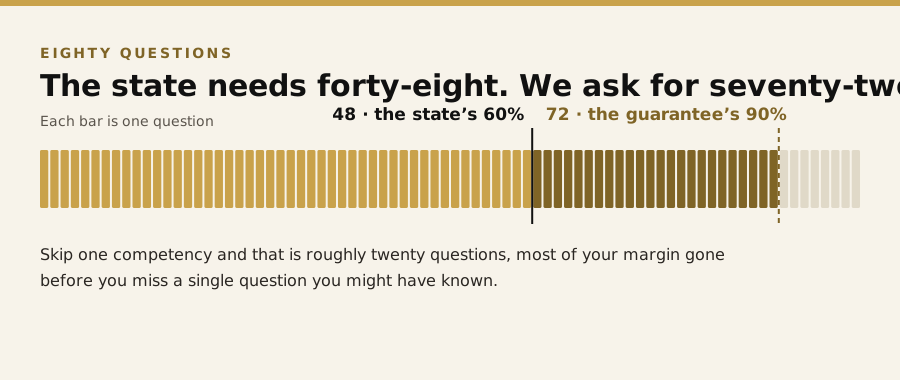
The exam is eighty multiple-choice questions, so sixty percent is forty-eight of them right. You can miss thirty-two and still pass.
That number is not set by your school. It is set by State Board of Education Rule 6A-10.02413, Florida Administrative Code, and it is the same for every student in Florida. There is no campus where the bar is higher, and no advisor who can move it.
Sixty percent of what, exactly
Straight percent correct. Forty-eight out of eighty.
That sounds obvious until you have taken a different standardized test. Plenty of them do not work this way. They convert your raw answers into a scaled score on some range that has nothing to do with how many you got right, and then the passing number is a point on that scale. Students arrive expecting the same thing here and start asking what the curve is.
There is no curve. There is no scaling, no adjustment for how hard your particular form was, and no comparison against how everyone else did that day. Count your correct answers, divide by eighty. That is your score.
This is genuinely good news, and you should let it change how you prepare. On a scaled exam you can never quite tell what a practice score is worth. Here, a practice test result means exactly what it says, so every honest practice run is a direct read on where you actually stand.
Why sixty percent feels easier than it is
Thirty-two questions of margin sounds enormous. It is the reason a lot of students walk in under-prepared.
It is also only half the requirement: for most students a course is required alongside it, which this post explains. Here is what the margin actually buys you. The exam draws from four competencies at roughly a quarter each, so a competency you never opened is about twenty questions. Skip one entirely and you have spent your whole margin before you have missed a single question you might have known. Skip one and have a bad day on another, and you are under.
The margin is not for the material you decided to ignore. It is for the questions that are genuinely hard, the ones where two choices both look right, and the handful you rush at the end.
What forty-eight looks like across four competencies
Spread evenly, forty-eight of eighty is twelve of twenty in each of the four competencies. Twelve of twenty is sixty percent, which is to say: passing requires you to be roughly this good at all four, not excellent at your favorite one.
Run the arithmetic the other way and you can see how the failures happen. Say you are strong in two competencies and get eighteen of twenty in each. That is thirty-six, and you only need twelve more from the remaining forty questions. Comfortable.
Now say you never opened Founding Documents. Call it five of twenty by guessing, since every question has four choices. You now need forty-three of the remaining sixty, which is seventy-two percent, from material you are merely okay at. That is a much harder exam than the one your classmate is taking, and you built it yourself.
The number to watch is not your total. It is your lowest competency.
We hold you to ninety, on purpose
On practice tests and the final mock, our bar is ninety percent. On eighty questions that is seventy-two, not forty-eight.
Not because the state moved. Because a score with no margin in a quiet room does not survive game day. You have a clock, a testing center, a lockdown browser, and whatever you brought in with you that morning. Twenty-four questions of cushion is what turns a pass on paper into a pass in the room.
It is also the Pass Guarantee requirement, not a slogan: the guarantee asks ninety percent on every practice test and the final. If you are hitting that, sixty on the day stops being a question you worry about. That is the whole design of the boot camp.
If you do not pass
You retake it. There is no statewide cap on attempts.
That is genuinely good news, and I would still rather you did not need it. Every retake costs a scheduling slot, a trip to the assessment center, and a few more weeks of carrying this around. The goal is to pass once and stop thinking about it.
If you have already taken it and come up short, the useful move is not to study everything again. Studying everything again is how you spend three weeks and move two points, because most of that time goes back into material you already knew. Find out which of the four competencies cost you the most and spend your time there instead.
Do that before you book the retake, not after. A retake scheduled for next week decides how you study this week, and studying without knowing your weakest competency is the thing that produced the first score. The free practice test is forty questions and reports by competency rather than as one number, which is exactly the read you need to aim the next few weeks.
Passing scores and policies can change, and your institution may have its own procedures for scheduling and retakes. Confirm with your advisor or assessment center.
Covers: American Democracy · The U.S. Constitution · Founding Documents · Landmark Impact
Keep reading
How advisors should talk about the FCLE
Accurate, forwardable wording for the three questions advisors hear most about the civic literacy requirement, and the phrasing worth avoiding.
How to study for the FCLE in two weeks
Two weeks is tight, not hopeless. What a fourteen-day plan can realistically move, and how to split the time across the exam's four competencies.
How the civic literacy requirement lands on your campus
Three cohorts, three rules, and the advising failure that sends students to graduation checkout unfinished. For advisors and assessment centers.