How the civic literacy requirement lands on your campus

Most of what goes wrong with Florida's civic literacy requirement is not a teaching problem. It is an advising problem, and it shows up at graduation checkout, which is the worst possible place for it to show up.
The statute is section 1007.25, Florida Statutes. The passing score on the assessment comes from State Board of Education Rule 6A-10.02413, Florida Administrative Code. Neither is long. The difficulty is not the text, it is that three different rules are live on your campus at the same time.
Three cohorts, three rules, one conversation
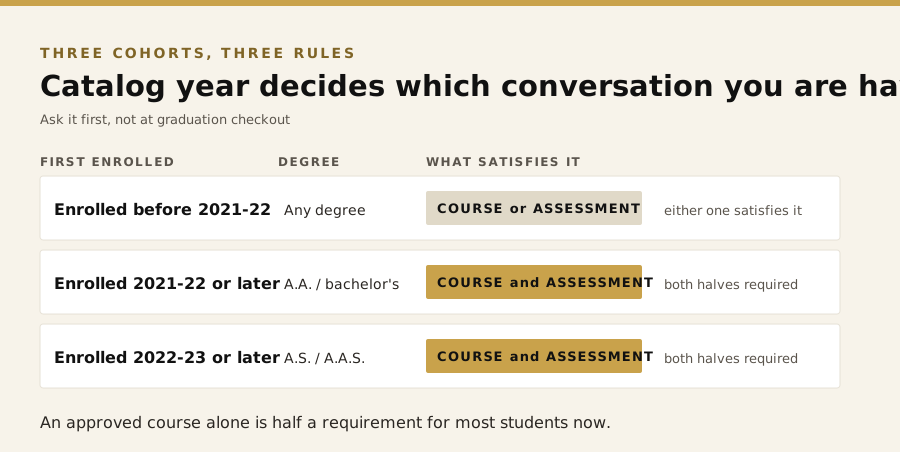
A student who first enrolled before the 2021-22 catalog year generally satisfied the requirement with an approved course or a passing assessment score. Either one.
A student who first enrolled in 2021-22 or later, working toward an A.A. or a bachelor's degree, needs both. For an A.S. or an A.A.S., the both-parts rule begins with the 2022-23 catalog year.
This is why so much of what students read online is confidently wrong for them personally. The either-or advice is not misinformation. It is accurate advice for a cohort that is no longer most of your caseload. We wrote that up for students here, and it is the single piece most worth putting in front of them early.
The practical consequence for advising: catalog year is not a detail you confirm at the end. It is the first question, because it decides which of three conversations you are having.
The failure mode is a partial answer
Here is the pattern I see most often. A student asks whether they have satisfied the civic literacy requirement. Someone checks, sees the approved course on the transcript, and says yes.
The course was real. The answer was half right. Nobody lied to anybody, and the student walks away believing they are finished with a requirement they are halfway through.
The fix costs nothing. Answer both halves explicitly, every time, even when only one was asked about. "Your course is done. Your assessment is not, and here is how to schedule it" takes four more seconds than "you're good" and prevents the version of this conversation that happens in a student's final term.
The same discipline belongs in your degree audit language. If the audit shows one requirement line where the statute has two conditions, students will read a satisfied line as a finished requirement.
Scores earned are not scores received
A qualifying AP or CLEP score can satisfy both halves at once at many institutions. Commonly accepted: AP Government and Politics United States with a 3 or better, AP United States History with a 4 or better, and CLEP American Government with a 50 or better. The student-facing version is here.
Those cutoffs are ordinary. A 3 on an AP exam is not a rare achievement, which means a meaningful number of your students may already satisfy this and not know it.
The catch is administrative, not academic. Students routinely assume that a score they earned in high school is a score your institution has on file. Those are different things. A score sitting at the College Board is doing nothing for a degree audit.
Two questions, asked early, resolve most of this: did you take AP Government, AP United States History, or a CLEP exam in this area, and did you have the scores sent here?
What actually moves a pass rate
If you are looking at a pass rate you want to improve, the instinct is to add review. More content, more coverage, another workshop.
The FCLE resists that approach for a structural reason. It is eighty questions across four competencies weighted at twenty-five percent each, so there is no high-yield section to concentrate on. Blanket review spreads effort evenly across material students have already mastered and material they have never seen, and the second group is where every lost point lives.
What moves a number is diagnosis before instruction. When you know which competency a student is weakest in, you can spend their limited time there. When you know which competency your cohort is weakest in, you can aim a workshop at something specific instead of reviewing everything for everyone.
That is a reporting question as much as a teaching one. A single percentage tells you a student failed. Four competency scores tell you why, and whether the problem is one student's gap or a pattern across your cohort.
Where we fit
Our free practice test is forty questions, ten per competency, and it reports by competency rather than as one number. Students can take it on their own, and nothing about it requires you to set anything up.
If the requirement is a real pressure point on your campus, that is the conversation we would rather have. We work with schools, districts and colleges on partnerships, including cohort-level reporting on where students are actually losing points. If you want the full picture of the exam first, the FCLE guide covers format, timing and scoring, and the requirement page covers the statute side.
Statutes, rules and institutional policies change. Confirm current requirements and local procedures with your registrar and assessment center.
Covers: American Democracy · The U.S. Constitution · Founding Documents · Landmark Impact
Keep reading
How advisors should talk about the FCLE
Accurate, forwardable wording for the three questions advisors hear most about the civic literacy requirement, and the phrasing worth avoiding.
How to study for the FCLE in two weeks
Two weeks is tight, not hopeless. What a fourteen-day plan can realistically move, and how to split the time across the exam's four competencies.
What is actually on the FCLE?
Eighty questions, one hundred sixty minutes, four competencies at twenty-five percent each. What each competency covers and where students lose points.