Federalist 10 vs Federalist 51: how to stop mixing them up

Both were written by James Madison. Both were published under the name Publius, a few months apart, arguing for the same Constitution.
That is exactly why students mix them up, and why the exam can separate the people who read them from the people who recognize the titles.
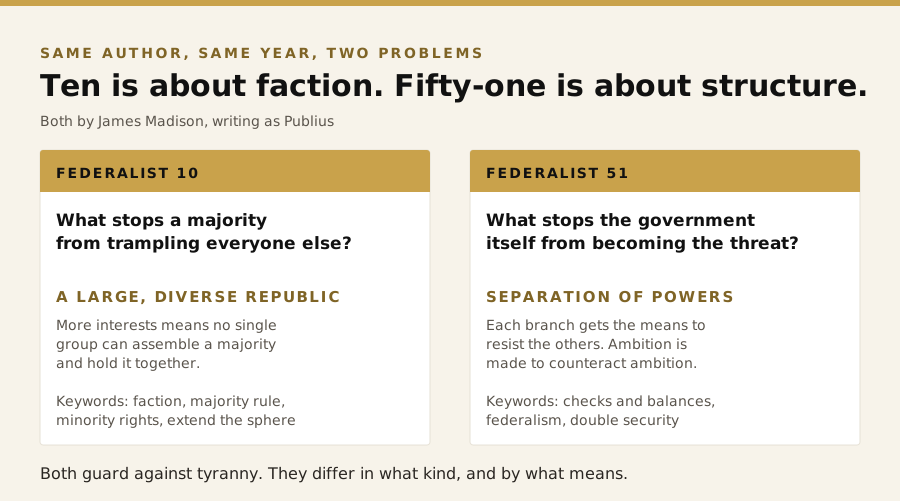
Here is the shortest honest version. Federalist 10 is about the danger of factions, and its answer is size. Federalist 51 is about the danger of concentrated power, and its answer is structure.
Federalist 10: the problem of faction
Madison starts with a worry, not a solution. A faction, in his definition, is a group of citizens united by a common interest or passion that runs against the rights of other citizens or against the good of the whole. Note that it can be a majority or a minority.
He then rules out the obvious fix. You could remove the causes of faction by destroying the liberty that lets people organize, or by somehow giving everyone identical opinions and interests. He rejects both. Liberty is to faction what air is to fire: you do not put out the fire by removing the air. Differences of opinion and unequal property will always produce factions, because the causes are planted in human nature itself.
So if you cannot remove the causes, you control the effects.
A minority faction is manageable, because it can be outvoted. The real danger is a majority faction, which can win legally and still trample everyone else. Madison's answer is counterintuitive: make the republic bigger.
In a large republic you get more interests, more groups, more competing ambitions. The more of them there are, the harder it becomes for any single group to reach a majority and hold it together long enough to do real damage. A small, homogeneous republic is more vulnerable, not less, because one faction can dominate it.
That is the argument. Extend the sphere, and a majority faction becomes hard to assemble.
Federalist 51: the problem of structure
Federalist 51 asks a different question. Granting that we need a government, what stops that government from becoming the threat?
Madison's most quoted line lives here: if men were angels, no government would be necessary. Since they are not, and since the people running government are not angels either, you need what he calls auxiliary precautions on top of the people's own control.
The mechanism is separation of powers with checks and balances. Each branch needs a will of its own and the constitutional means to resist the others. His phrase for it is that ambition must be made to counteract ambition. You do not rely on officeholders being virtuous. You arrange the offices so that each one's self-interest works against the others' overreach.
Federalist 51 also describes what he calls a double security: power is divided between the federal government and the states, and then divided again among branches within each. Two separate divisions, guarding from two directions.
The distinction that actually gets tested
Both essays are about protecting against tyranny. They differ in what kind and by what means.
- Federalist 10 guards against a tyranny of the majority, coming from society, using the size and diversity of the republic.
- Federalist 51 guards against a tyranny of government itself, coming from concentrated power, using the architecture of the branches.
If a question mentions factions, interest groups, majority rule threatening minority rights, or the advantages of a large republic, it is pointing at Federalist 10. If it mentions separation of powers, checks and balances, ambition counteracting ambition, or the division between federal and state power, it is pointing at Federalist 51.
One caution, because the exam is written by people who know this is where students get comfortable: Federalist 51 also revisits the multiplicity-of-interests idea from 10, and Federalist 10 touches on representation. The two are not sealed off from each other. What you are being asked for is the central argument of each, not the only idea that appears in it.
Where these sit on the exam
The FCLE names five Federalist Papers in its blueprint: numbers 10, 14, 31, 39 and 51. That short list is under Founding Documents, one of the four competencies, each worth twenty-five percent of your score.
The ideas in these two essays also reach past that competency. Separation of powers, checks and balances, majority rule with minority rights, and federalism are all concepts under American Democracy as well. That is what makes Federalist 10 and 51 efficient to study: you are working two competencies at once.
The two are short. Madison wrote them to be read by ordinary citizens in a newspaper, and they hold up. You can read the full texts at Congress.gov, and I would rather you spent twenty minutes there than an hour with someone's summary, this one included.
When you want to know whether it stuck, our free practice test is scored by competency, so you will see Founding Documents as its own number instead of buried in a total. If that number is where your gap is, the boot camp works through this competency one piece at a time, and the full FCLE guide lays out how the rest of the exam is built.
Covers: American Democracy · The U.S. Constitution · Founding Documents
Keep reading
How advisors should talk about the FCLE
Accurate, forwardable wording for the three questions advisors hear most about the civic literacy requirement, and the phrasing worth avoiding.
How to study for the FCLE in two weeks
Two weeks is tight, not hopeless. What a fourteen-day plan can realistically move, and how to split the time across the exam's four competencies.
How the civic literacy requirement lands on your campus
Three cohorts, three rules, and the advising failure that sends students to graduation checkout unfinished. For advisors and assessment centers.